
In this week’s essay, I write about how the advent of new technology often causes people to trade quality for convenience. Or maybe I’m just too extreme. Also, I wrote quite a bit about AI visuals and lifehacks for health and travel. I also appeared on CNA Talking Point and travelled to Bangkok to share my vibe coding techniques with alumni from my university.
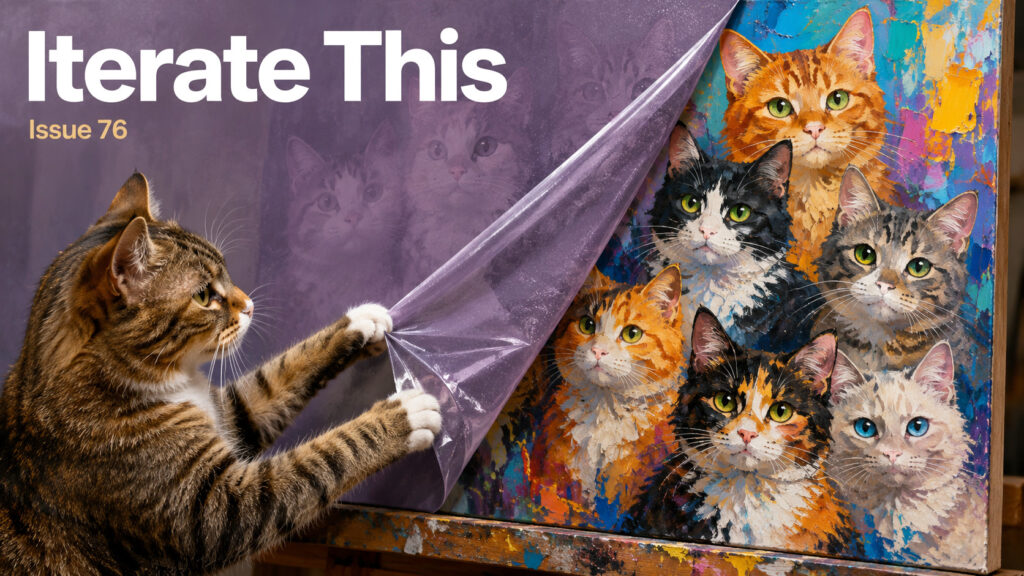
Photo of the Week

6 June 2026, Bishan Park
Weekly Recap
Gen AI visuals should be a starting point for you to iterate on, not your end point. I think ChatGPT Images 2.0 is great but the content of the visuals tend to be too verbose. Now we are flooded by them.
I also think schools should start using Gen AI to freshen up the visuals used in their assessment papers and exams. The AI errors in the images can be fodder for discussion.
I was excited to be on CNA’s Talking Point show and it was hosted by Diana Ser. The topic was about retrenchments and AI. My part was on AI upskilling and I got to show a regional audience how I teach vibe coding. The video will be on YouTube soon but you can watch it first on MediaCorp MeWatch.
More upskilling! I was in Bangkok for a day to give the first faculty masterclass for the NTU Alumni Regional Conference. This time, the live vibe coding demo didn’t go smoothly but I survived.
OpenAI launched ChatGPT Work to compete with Claude Cowork. I tried ChatGPT Work, accidentally burned a lot of tokens, and wasn’t too impressed. But it’s early days.
The perplexing relationship between our fate and our will, as mentioned in Stephen Fry’s Mythos. The book is currently S$3.86 on the Amazon Kindle Store.
Travel lifehacks – Why I now bring two laptops and two portable speakers when I work overseas.
Health lifehacks – Why I carry hardboiled eggs onto the train and why I often think about my 2012 self.
Xbox laid off a lot of people this week, after years of poor management and wasted billions. As an ex-Xbox guy, I have many thoughts about this.
Sunday Essay
I’ve learned that when new technology comes along and people are asked to accept it without questioning, something important can get lost in the process and that reveals a disturbing aspect of human nature – many will trade quality for convenience.
In the early 2000s, I was a young photojournalist at The New Paper and we were doing a big transition from film to digital cameras. The parent company Singapore Press Holdings had decided to invest in the hot DSLR of that time – the Nikon D1 – and I hated that camera to the core.
While it handled like a traditional Nikon DSLR, I found that it produced images with unpleasant colours. D1 photos often had a purplish or bluish pallor. It was like someone poured a very thin film of greyish-blue liquid over every photo. I grew up using vibrant Kodak and Fuji films and to me, this was unacceptable. The purplish photos looked even worse when printed on greyish newspaper print stock.
However, nobody in the newsroom fussed about it, and I thought I was the insane one. My photo editor didn’t complain, the sub-editors who laid out the pages didn’t complain, and no reader complained either! Were my eyes playing tricks on me? Was I being extremist in my passion for vibrant colours?
I poured myself into fixing this problem. I found out that yes, other photographers worldwide were complaining about the magenta cast, and it was due to Nikon using the NTSC colour space instead of sRGB. There were different online solutions for it (here’s one example) and I came up with my own Adobe Photoshop filter to correct the colours. I shared the hack with my colleagues, and most of them didn’t care to use it.
There seemed to be a general consensus that we were in the early days of digital photography and that we should just accept that these digital sensors were not perfect. After all, readers didn’t seem to be unhappy.
I put up with the problem until I quit the Photo Department in 2003 to go back to writing. When the newsroom bought newer DSLRs, the colour problem went away… but was it just a problem in my mind? Was I being unreasonable in being a stickler for image quality? Was I being resistant to technological change (I mean, never assume anything)?
History always repeats itself, and now as we transition to the AI age, the same problem is happening but at a much larger scale, across every aspect of work. People getting AI to write emails, newsletters, and reports without a soul. Trying to automate work that should not be automated. Using agents for the sake of doing so and burning tokens unnecessarily. Some people boast that they can now do the job of a marketer and generate an ad in a few minutes, but was that ad actually well-designed, and did it capture the attention of the audience?
I know it gets confusing for the reader – why is Ian teaching people how to embrace AI, and also getting upset about how people use it?
Answer: Because since 2023, I have always taught that humans need to steer AI, not the other way around. The more AI we use, the more human we need to be. If AI produces something that looks pixel perfect, and everyone produces pixel-perfect content, then what differentiates your content from the others? Simply this – did you put your heart in it? Did you think about how your audience would think about it? So what if AI helps you to save time in your job… did it make the output bland and blah?
I often show the Gamma AI demo in my workshops – “See, it can create a PowerPoint deck in a few seconds! But wait, notice how the fonts are often too small for a middle-aged audience, the layout is too generic, and the generated images can have distortions. You still have to download the file and fix it manually in PowerPoint.”
Focus on the quality of the output, not just how quickly you can make it. AI can help you in both areas, but you call the shots. Never lower your standards, only raise them.
12-Jul-2026