
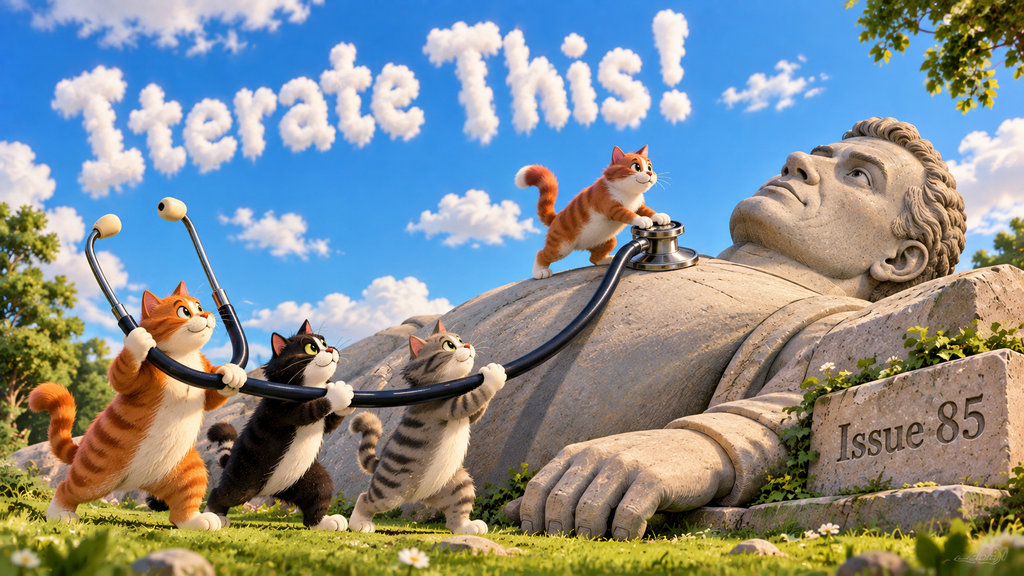
In this week’s newsletter, I ask whether you know you are dead. My weekly recap has articles on feeling tired of explaining my AI philosophy to young people, avoiding burnout with a simple approach, understanding what AI actually does to you, why I don’t complain about SG ministerial salaries and why I am not buying an iPhone Duo.
Weekly recap
I find it easier to teach AI to older adults than young people. Because it’s tiring to explain that one can be balanced in using AI.
“Burnout” is not in my dictionary, mainly because I have never allowed it to happen to me. I believe we should work as much as we work, if not more. The only question is whether the work was truly productive.
If you are worried or excited by AI, here’s why.
The Apple iPhone Duo is phenomenally expensive, but only because I’m not the target market for it. I’d also advise people to think twice about buying a foldable. In case you think I’m a hater, I do own a suite of Apple devices (phone, tablet, laptop, Apple TV) and an Android foldable.
I teach my students how to sketch every semester, and ChatGPT Images 2.5 just demonstrated why they should.
Please read this NYT gift article on the microplastics epidemic in Indonesia.
I also like to annoy anyone with “Fractional” in their self-declared title. I really think we should stop using such a divisive word. Heh.
Ministers in Singapore getting a big raise! Many people are upset but I’m not.
A trip to an IT Show, which somehow hasn’t died out yet in Singapore.
Sunday Essay
It was 1998, the second year of my university course in communication studies and my lecturer was furious with us. She was teaching a difficult module in world history that required us to do the impenetrable readings on philosophy. Of course, most of us had not done the readings and we were unable to respond to her increasingly agitated questions.
She glowered at us and declared, “You are all zombies! You go through life as a dead person, and you don’t even know you are dead!”
Everyone sank into their seats. That statement coursed through my entire body and I have never forgotten how I felt – utterly ashamed. More importantly, it reprogrammed my brain on the spot. I said to myself, “I don’t want to be a zombie, I don’t want to be dead. No, no, no.”
Of course, as a lecturer myself today, I don’t make such hard-hitting statements to young people because I’ll probably get cancelled. But I sometimes tell it to others as a personal story about how her scolding really shaped my life trajectory. Really, such a wake-up call is needed more than ever today with all the phone zombies walking around.
How does one become a zombie? My answer is simple: you consume more than you create.
In the 1985 horror film The Return of the Living Dead, the embattled humans manage to capture a zombie and interrogate it. Here’s the clip on YouTube (not for the faint-hearted) and the slightly edited script:
Man: “Why do you eat people?”
Zombie: “Not people, brains.”
Man: “Why?”
Zombie: “PAIN! The pain of being dead! I can feel myself rot.”
Man: “Eating brains, how does that make you feel?”
Zombie: “It makes the pain go away.”
I think that’s a pretty good analogy of why so many people just keep staring at their devices and consuming content all day long. The endless content provides a pleasing stream of dopamine hits and before they know it, hours have passed. Some people are more tolerant of AI slop, so they don’t mind watching infinite variations of AI microdramas. The minute phone addicts put down their devices, they feel an urge stronger than nicotine addiction, because they don’t know how else to deal with boredom or listlessness.
But hey, I also do the same activities to relax. I watch streaming TV, I play games, I read Reddit. I just don’t do it all day long because I spend more time creating than consuming. I’m a phone addict when I am bored, so I resist actively by creating throughout each day.
When I say “creating”, I don’t mean just writing newsletters like this or my daily LinkedIn posts. I’m always designing new decks for new workshops, new hands-on exercises and projects to teach others AI and non-AI skills, new AI demos that are deployable in workplaces, figuring out new ways to use AI workflows, and so on.
I also create future opportunities by meeting people over coffee to discuss collaborations, by learning the new features of the latest AI apps, by proposing ideas to my training providers for next year’s workshops, and so on.
Creating can be defined in many ways, and to be clear, you should focus on creating value for others.
Creating an AI-generated image produces a visual that has zero value in itself (since anyone could do it with the same prompt) but it’s the content in the visual that can provide value to others (advice, ways of thinking, new information).
Creating value requires proper distribution, which is also more work. You can pour your heart and tears into writing a fiction book, but if nobody knows it exists because you haven’t done any decent marketing, then you have not been able to transmit your value to the public.
That’s why many people complain that they are not appreciated for the work that they do – either they have not worked at selling themselves or their work, or perhaps the work was just not valuable. They may get angry, they may stop creating, then slowly they may turn into zombies.
Create more than you consume. You will feel more alive than ever.