
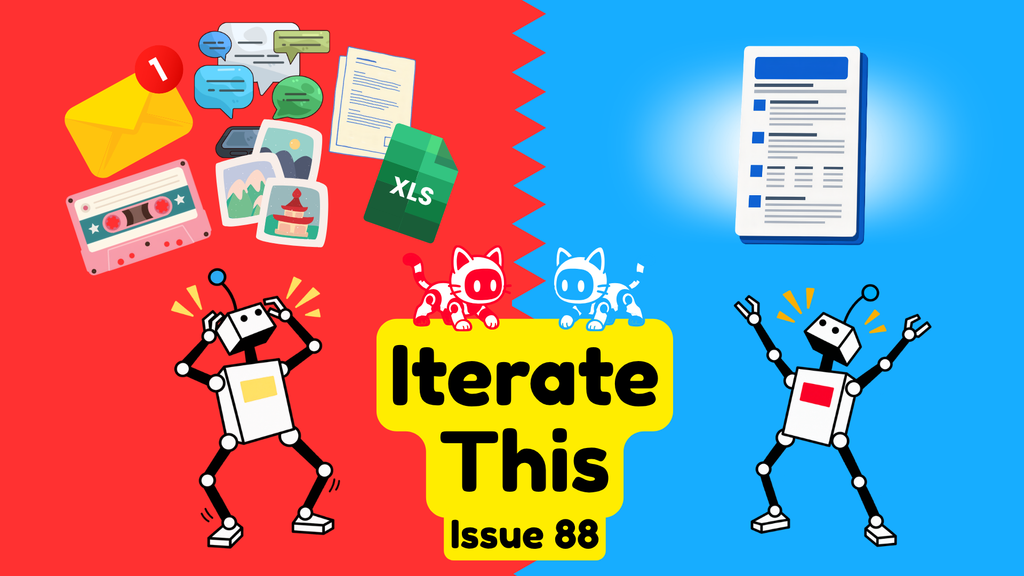
In this week’s newsletter, I tell you why many people create knowledge bases that AI struggles to read properly. In my weekly recap, I write about the first reported AI-related data breach in Singapore, Andrew Ng’s controversial advice, and the end of Gemini’s honeymoon era for free users. I also share two AI lifehacks for the Chrome browser that I created this week. Finally, this week’s key visual was made with Canva and ChatGPT. Can you identify which elements were AI-generated with my prompts?
Weekly Recap
It’s finally happened. The first reported AI-related data breach in Singapore. But it was more of a people problem than an AI one.
Please heed this controversial advice from Andrew Ng: Everyone should learn how to code. I firmly believe he’s right, even though I struggle with coding.
The honeymoon era of Google Gemini for free users is coming to an end.
At least you can still use my Gemini x Chrome lifehack for free.
I also vibe-coded my first Chrome extension to help me translate Chinese text more efficiently. Download it here.
OpenAI wants you to use its new AI agents called “dots”. Well, if you are willing to pay. (I’m not.)
Thank you to LinkedIn News Asia for featuring me as one of the AI voices to follow.
Also, thank you to the National Translation Committee for inviting me to be a guest speaker at their conference.
Turning a standard laptop into a gaming or local AI machine with an eGPU.
Singaporeans continue to eat too much of the wrong things.
Don’t bother with such people. And also such people.
Sunday Essay
Imagine you just joined a team, and the boss throws you a huge folder with thousands of documents in different formats. Then the boss says that every time there is a customer query, you must go through all the documents and give the right answer within the next minute.
Not possible right?
Many people are making the same mistake by making AI do too much heavy lifting when querying a knowledge base.
They dump multiple files of different formats into a folder and then expect AI to figure out how to extract the right information every time. The folder could include emails, documents, photos, spreadsheets and other PDFs. The idea of doing this “search my folder for relevant content” has been popularised by AI influencers trying to promote AI apps.
Yes, it sounds logical that as long as you compile as much information as possible, AI should be able to read all that information. Well, only if you have massive computing power on tap, which we don’t. Instead, you’re choking AI with too much information and wasting too much energy. That’s why people keep complaining that AI does not give them correct answers consistently, it gives up before looking through your entire treasure trove.
That’s why even though you can upload 50 documents into a Gemini Notebook for free, you should only upload one or two documents with the required information!
The average person is probably not aware of how computers work, and that’s one of the major reasons why they are struggling to leverage AI for knowledge work. However, we gaming geeks who have had to deal with the limits of computing power for the past 50 years know this idea of eking out efficiency from machines.
One best practice is to use a MASTER DOCUMENT, and apply the universal principles of filtering and cleaning data. Follow these steps:
- Filter your data so that only the truly necessary data is used, ensuring the data is of the same topic or theme.
- Then clean the data to remove outdated, duplicated, and wrong data.
- Compile the filtered and cleaned data into a **master document, or a single source of truth.
- Make sure your document is in the lightest file format possible (text/markdown or CSV data files).
- Then point AI at that master document and it will be able to find and process the right information more accurately and more quickly.
A scanned PDF file is the worst thing you can ask AI to search through as it has to convert images to text first, and mistakes will be made. Always use a lightweight file format like .txt, .md, .csv
The good news is that you don’t even have to compile the master document yourself. You can build it with AI’s help:
- Create a baseline document.
- Ask AI to update the baseline document with any new data uploads.
Your job is to verify that the updated information is accurate and that the master document does not have any duplicated or erroneous information. The master document will also swell in size over time and you need to keep trimming it to ensure the content remains relevant and useful.